| $e^{i\pi}+1=0$ |

|
| $\int_0^\infty e^{-x} dx = 1$ |

|
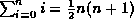
| $\sum_{i=0}^n i = \frac12 n(n+1)$ |
|
For further explanation, see below.
- Comprehensive LaTeX Symbol List (local copy)
- MiKTeX is best for Windows (all current versions)
- Prosper - Produce nice slides - like Powerpoint but with the mathematics set properly!
- LyX - Document Processor (WYSIWYM)
- Publish mathematical documents (written in LaTeX) on the Web using LaTeXtoHTML.
- Get all the TeX (and TeX related) information and software you need from CTAN, the Comprehensive TeX Archive Network
- TeX Users Group (TUG)
-
My own set of LaTeX examples and exercises.
First, ask your local wizard how to run TeX.
For each lesson, download the source,
read it, run it, look at the result, and then do the exercise.
Lesson 1 2 3 4 5 6 Basic More Equation Definitions Bibliography Including commands commands arrays and lists and theorems graphics Example ex1.tex ex2.tex ex3.tex ex4.tex ex5.tex ex6.tex figure1.pdf Exercise ass1.pdf ass2.pdf ass3.pdf ass4.pdf ass5.pdf -
Knuth developed a system of `literate programming' to write TeX, and he provides the literate (WEB) source of TeX free of charge, together with tools for processing the web source into something that can be compiled and something that can be printed; there's never any mystery about what TeX does. Furthermore, the WEB system provides mechanisms to port TeX to new operating systems and computers; in order that one may have some confidence in the ports, Knuth supplied a test by means of which one may judge the fidelity of a TeX system. TeX and its documents are therefore highly portable.
TeX is a macro processor, and offers its users a powerful programming capability. For this reason, TeX on its own is a pretty difficult beast to deal with, so Knuth provided a package of macros for use with TeX called plain TeX; plain TeX is effectively the minimum set of macros one can usefully employ with TeX, together with some demonstration versions of higher-level commands (the latter are better regarded as models than used as-is). When people say they're "programming in TeX", they usually mean they're programming in plain TeX.